
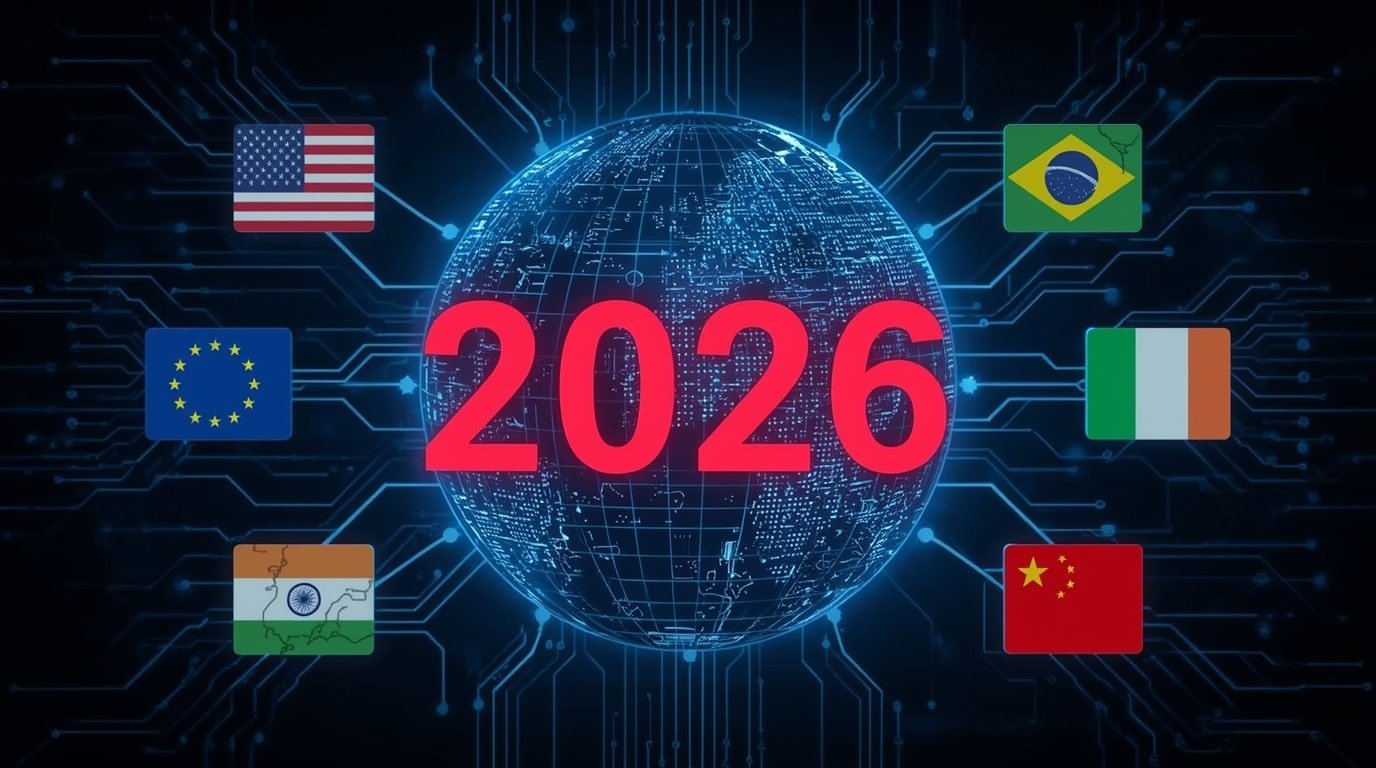
In a world where data drives all decisions of the company, whether in marketing strategies or product innovations, the regulatory noose is closing. By the close of 2025, a series of changing data protection requirements will pose a domino of emerging global business influences that may transform the world of operations by the beginning of 2026.
Those who fall behind face fines in the billions of dollars as well as reputational losses and overhauls of their operations. As the GDPR in the European Union begins its seventh year of operation and other regulations, such as the Digital Personal Data Protection Act in India, continue to amass momentum, businesses can no longer afford the luxury of acting slowly. This article unravels the earthquake in the world of data legislation and defines the essential changes that should be made to remain in compliance and competition.
The Changing Data Protection Regulations Landscape
The world data protection environment has ceased being a collection of separate regulations but an interwoven network that requires concerted effort to follow. Still ahead is the General Data Protection Regulation by the EU, which has affected more than 130 countries since 2018.
However, 2026 will bring in increased enforcement, as the European Data Protection Board announced tougher audits of cross-border data flows in tense conditions of post-Brexit relations between the United States and the European Union, as well as in the context of adequacy talks between the two sides.
The United States is dividing its tactics across the Atlantic, though the Consumer Privacy Act of California, with the 2023 amendments to the Privacy Rights Act, establishes a new national tone. By mid-2026, companies that process the data of 100,000 or more Californians should provide more granular consumer rights, such as the deletion of data and the ability to choose against automated profiling. Following this, as Virginia and Colorado’s comprehensive privacy laws will result in broader requirements of high-risk processing, which will require an impact assessment by the end of the year.
There is a rapid convergence on emerging markets. Extraterritorial scope is introduced in Brazil by Lei Geral de Protecao de Dados Pessoais (which was fully enforced as of 2023) and fines non-compliant multinationals up to 2% of world revenues.
China has had a law on Personal Information protection since 2021, with 2026 guidelines regarding the transparency of the algorithm, whereas India has a law on the DPDP Act, which was introduced in 2023 and implemented gradually. Important data custodians, India-based data protection officials, should be designated by early 2026, and the consent form should be as stringent as GDPR.
The African story gains pace, with Nigeria implementing the Data Protection Act 2023 and South Africa making amends to its POPIA to ensure that the sensitive data is localised by 2026. Such overlapping means the beginning of a new era: the sovereignty of data is king, and ignorance is no longer an option.
Major Compliance Revolutions: Consent and More
Companies cannot rest on their laurels; they require fundamental rewiring. First of all is consent management. In revised regimes such as the post-GDPR change of the UK and privacy reforms to the Privacy Act in Australia, implied consent will disappear. Firms need to switch to clear, finer granular opt-ins, which could be verified through digital timestamps and readily revoked through easy-to-use tools.
In the case of e-commerce, it implies redesigning cookie banners and newsletter subscriptions, lest these become the so-called dark patterns, which pressurise users into obedience-fines of this nature, which occurred already under EU legislation last year alone, amount to EUR20 million.
The other pillar is transparency reports. By 2026, Brazilian LGPD and EU AI Act entities are required to release a yearly data processing inventory, showing data gathering flows to erase. This openness also applies to notifications of breaches: schedules are reduced to 24 hours in jurisdictions such as the revised legislation of Quebec, and force real-time incident response teams. Companies that were using ambiguous and vague privacy policies will have to have AI-vetted documents, with plain language that de-mystifies the use of data.
The principles of minimalism in data gathering are accelerated, with the companies gathering the minimum possible. Any retailer scanning loyalty programs or apps that track transactions via fintech is required to undergo privacy by design audits, which entail protection by design. Non-compliance? Class-action tsunamis will be expected, as witnessed in recent Meta settlements of over $1.3 billion.
Addressing Cross-border Data Issues
International business increases the risks. The Schrems II case has had its effect, and it nullified any unlimited transfers of the United States under the EU law and brought about the timeline of 2026 to certify Data Privacy Frameworks.
The enterprises that transfer data between continents have to systematise their routes, implementing encryption and pseudonymization to meet the requirements of adequacy. As an example, cloud providers such as AWS and Azure are required to localise their servers in the EU or India, which is costly, yet they avoid transfer bans.
Efforts on harmonisation, like the model contractual clauses of the ASEA, provide lifelines, but customisation prevails. A U.S. SaaS company with EU clients can involve vendor evaluation in contracts, checking the compliance of third-party vendors. A breakdown in this case causes supply chains–suppose there is a frozen ad-tech pipeline that costs millions of dollars a day.
Resilient Privacy Technological Shifts
Innovation is not a choice; innovation is a necessity. With the spread of AI, such laws as the AI Act of the EU place biometric tools in the high-risk category, which must be assessed in conformity by 2026. Companies implementing chatbots or facial recognition have to integrate bias audits and human controls because they should no longer address fixes but establish a proactive governance approach.
Privacy-enhancing technologies come up to the challenge. With homomorphic encryption, it is possible to perform computations on encrypted data, and this is ideal in the health tech companies in regards to the 2026 expansions of the HIPAA regulations.
The training models without centralisation of data are Federated learning, which fits the ethos of minimisation. The bet in this area is richly rewarded: early adopters claim to achieve 30% efficiency and reduce the risks of breaches.
Operational adjustments are not an exception. C-suite CPOs, on top of cross-functional teams, face quarterly compliance exercises become standard. Training initiatives no longer stay with the yearly email; instead, it is an all-encompassing simulation, creating a culture of data ethics over quarterly quotas.
Roadmapping to 2026: Urgent Action Items
Timelines are merciless, with less than a year to change direction. Immediate starts are required in Q1 2026 due dates the India DPDP notifications and EU transfer impact assessments. Start with gap analysis: a series of inventory data assets, comparison with the regimes such as the PIPEDA updates in Canada, and focus on high-exposure areas such as customer databases.
Use judicious experts – engagements can speed up, but ownership through in-house gives sustainability. Expenses to cover tools: OneTrust or BigID consent platforms make the workflow smoother, which is recovered through the prevention of fines. One region has pilot programs that scale up their success as it rolls out nationwide to avoid rollout pitfalls.
The reward goes beyond evading. Compliant companies gain access to trust, and 70% of consumers prefer privacy-oriented brands, according to surveys. This in boardrooms translates to robust strategies, which are free of regulatory whiplash.
With 2026 coming around, data protection is not a box to be ticked but the foundation of a lasting enterprise. The companies that will not only survive but even become the top in a data-driven world where privacy is the new currency are the ones that will adopt these changes. The time goes on; the decision is evident.