
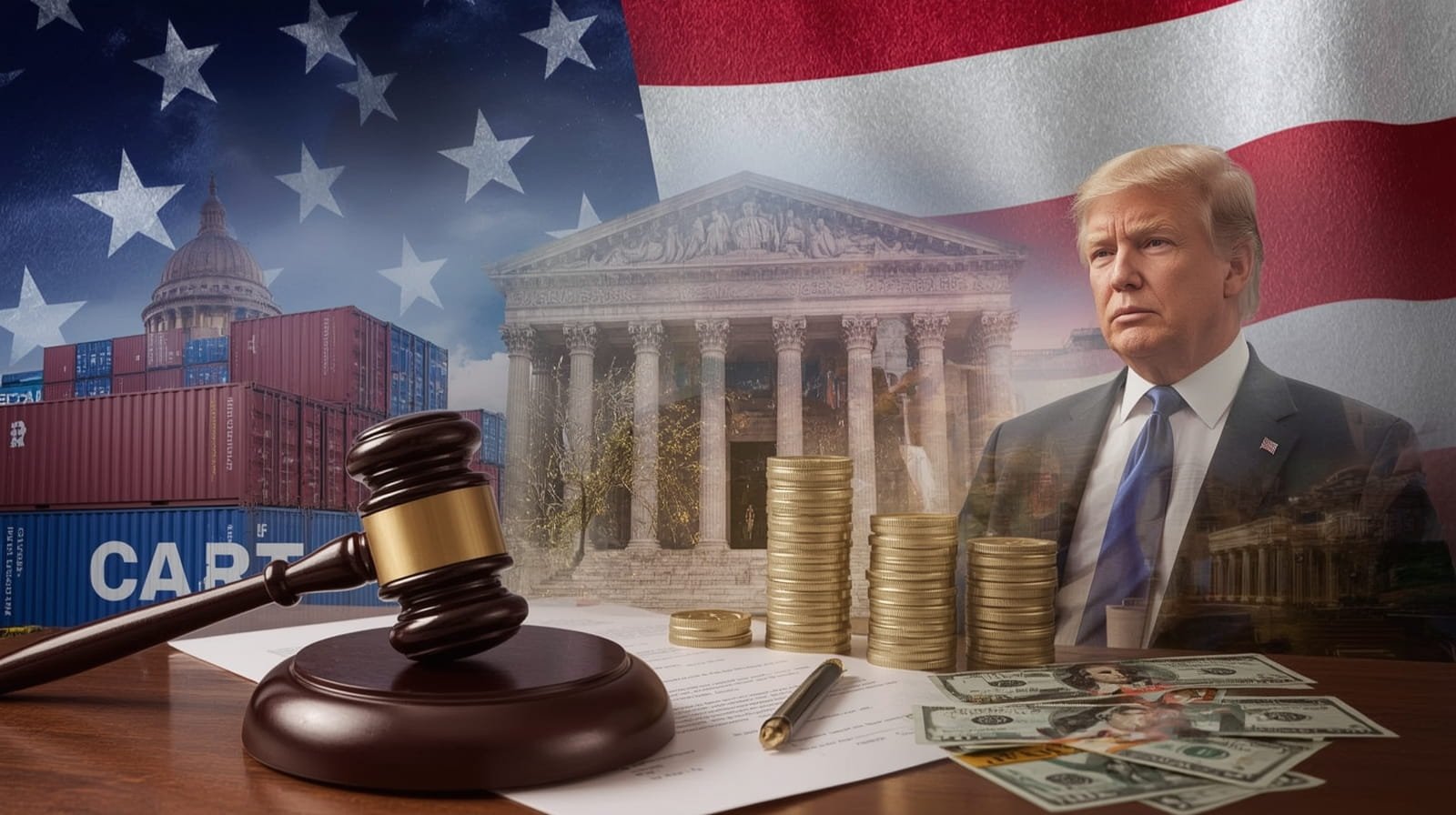
In a major turn in legal confrontations over the aggressive trade policies of the current president, Donald Trump, a federal judge has ruled that the United States government should begin distributing over 130 billion dollars in refunds to businesses affected by tariffs already in effect.
This ruling, delivered later on March 5, 2026, is another court blow to the administration’s application of executive power in international trade. The decision is making waves in the business world, with firms scrambling to understand its impact on their businesses and budgets.
The order follows a historic Supreme Court ruling in the past month that struck down far-reaching reciprocal tariffs imposed by Trump, claiming they exceeded presidential authority. Retailers, logistics companies, and businesses are all eagerly awaiting clarification on how they can recover the money they paid for what are now being declared by the courts as illegal levies.
The judge’s directive not only requires the issuance of refunds but also simplifies the system by appointing one court to handle all relevant claims, which may require the issuance of resolutions to thousands of affected importers.
The History of the Tariff Controversy
The saga began when Trump invoked the International Emergency Economic Powers Act of 1977 to impose universal tariffs to address the alleged trade imbalance. These policies, which were aimed at protecting local industries, were met with criticism for causing a rise in costs and disrupting the global supply chain. In a 6-3 decision on February 20, 2026, the Supreme Court held that this violated Congress’s constitutional powers in taxation and trade regulation.
Untrustworthy, the administration immediately shifted to other grounds of the law. Trump signed a new 10% global tariff on February 24, 2026, under Section 122 of the Trade Act of 1974, and there are signs that it will soon be raised to 15%.
This facility has enabled temporary tariffs to remedy imbalances in the balance of payments, but critics have claimed that the facility is being abused in the current economic conditions, where the U.S. operates under a floating exchange rate regime rather than a fixed rate regime, pegged to obsolete standards such as the gold standard.
To make matters worse, the U.S. offered India a 30-day waiver on March 6, 2026, allowing India to import Russian oil and petroleum products that had previously been on their way. This will alleviate the immediate pressures on India, which has been subjected to 25% tariffs to keep making purchases with Russia amid geopolitical tensions between the two countries. Nevertheless, it highlights the hodgepodge of existing trade enforcement, as overall tariff policies are still undergoing changes.
Information on the Latest Court Decision
In his decision of March 5, 2026, the U.S. Court of International Trade Judge Richard Eaton underlined that all importers of record must be refunded, notwithstanding the fact that they have not filed lawsuits. This broad interpretation may include claims amounting to up to 170 billion dollars, resulting from tariffs paid on a wide range of goods since the policies were implemented. Eaton did not agree to a 90-day delay as demanded by the government and instead demanded that the process start immediately to avoid causing any further harm to the business.
The decision appoints Eaton himself as the judge for consolidated cases and thus prevents disjointed proceedings across different courts. As much as this centralisation has been applauded by legal professionals for its efficiency, the administration has already made it clear that it intends to appeal (or seek a stay), which would only further increase the uncertainty. More than 2,000 companies, among them such household names as Costco, FedEx, and L’Oreal, have brought suit, and many have vowed to refund customers whatever amounts are recovered.
Stakeholder and Policymaker Response
The ruling has brought mixed reactions across the political and economic divide. Democratic officials, including Senator Elizabeth Warren, have celebrated it as a win over the usurpation of the executive, saying the administration is slowing down refunds in what she has called the outright robbery of American businesses. Senate leader Majority Chuck Schumer shared the same sentiments and demanded an immediate execution of the same to relieve the inflationary pressures caused by the tariffs.
In business, the executives are not very optimistic. The CEO of Lowe’s observed that the refunds have not been included in the financial projection so far, as they are expected to take time, but the decision offers a better way forward.
Farm organisations, such as the National Corn Growers Association, drew attention to the persisting difficulties farmers face, including market volatility amid retaliatory actions by trading partners. On the global scene, the European Union has also stalled ratification of an impending trade agreement with the U.S. in a bid to seek guarantees that no new tariffs will weaken the deal.
The Trump administration, in the person of Treasury Secretary Scott Bessent, argues that the new tariffs are needed to deal with decades-long trade deficits and will be replaced by previous rates within five months.
Nonetheless, the legal opposition by states such as New York, California, and Oregon, filed on March 5, 2026, challenges the legitimacy of Section 122’s application because it does not apply when the economy is not in a balance-of-payments crisis under fixed exchange regimes.
Economic Competition and Prospects
Economists have cautioned that the tariffs are already causing inflation to rise, with the Federal Reserve estimating that inflation would increase by 0.5-0.75 percentage points. The most recent Beige Book report, published on March 5, 2026, states that companies are shifting expenses to customers, slowing expansion across major sectors. In 2025, Canadian exports to the U.S. decreased by 5.8% due to tariffs on vehicles, steel, and forestry products, which has put pressure on bilateral relations.
In the future, the refund process may take years and may involve complex audits and even a second trip to the Supreme Court. In the meantime, the U.S.-Mexico-Canada Agreement is up for renewal on March 16, 2026, which is likely to be another mess in trade relations. With the midterm elections approaching, the administration is facing an affordability crisis and is considering reconsidering the metals tariffs.
This is not only a legal drama in which the limits of presidential authority in the trade law are put to the test, but also the delicate balance between serving local interests and ensuring stability within the global economy. The future of U.S. trade policy will still be observed as courts define it in 2026.