
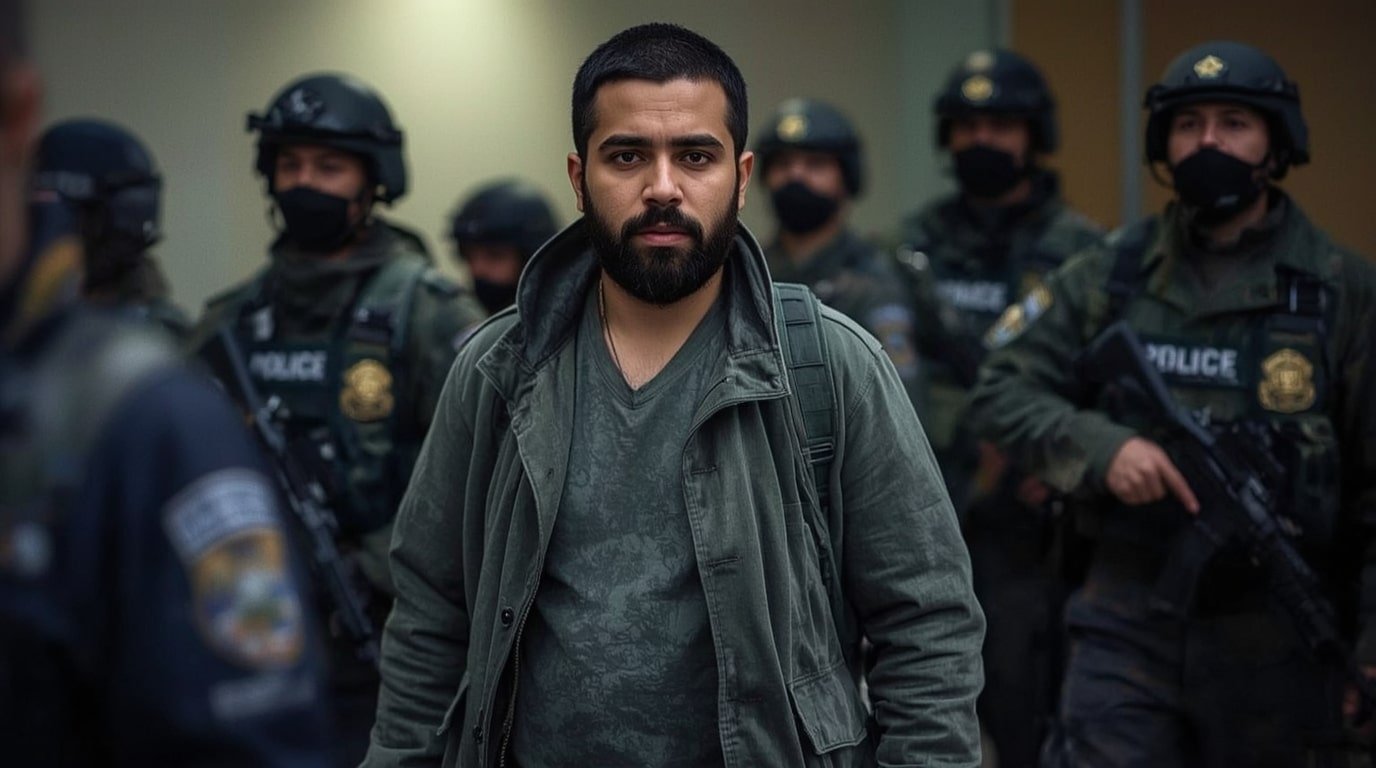
The Hague, Netherlands – In the first instance of international responsibility, it was declared, on December 1, 2025, by the International Criminal Court (ICC) that it has seized Khaled Mohamed Ali El Hishri, a senior Libyan militia officer, allegedly involved in the design of atrocious violations at one of the most notorious detention centres in the country.
This handover by the German authorities is the first occasion when a Libyan suspect has been detained by Ian CC prison facility, which is an indication of a possible turning point in the long journey to justice for victims of the Libyan civil war.
On July 16, 2025, El Hishri was extradited to The Hague following months of courtship proceedings and was arrested in Berlin Brandenburg Airport.
This sealed arrest warrant, issued earlier this year by the ICC, accuses El Hishri of orchestrating or directly witnessing crimes against humanity and war crimes in a period between February 2015 and the early part of 2020 as a senior commander at Mitiga Prison near Tripoli.
Under his rule, thousands of prisoners of various kinds, such as civilians, migrants, and suspected opponents, all went through extended periods of detention, as reported by the court records.
Scandalous News Surfaces out of the Mitige Shadows
Mitiga Prison, which was occupied by the Al-Radaa Special Deterrence Forces army in the chaotic conditions of post-Gaddafi Libya, became the symbol of cruelty. According to the ICC charges, the system of systematic torture has been described in which guards beat, shocked, and waterboarded prisoners.
There was sexual violence, and at least five detainees, among whom there was a 15-year-old boy, were reported to have been raped by prison staff or fellow detainees under the leadership of El Hishri. Women were subjected to selective sexual abuse, worsening the reputation of the facility as a black location of human rights abuse.
Prosecutors allege that El Hishri did not merely condone such activities but was directly involved and personally killed one of the detainees and set up rules that would cause the most pain, including refusing medical treatment and overpopulated cells.
He had total control over the employees and prisoners and made the prison a house of terrors, according to an ICC statement. These accusations are based on the testimonies of the survivors, forensic evidence and the intercepted communications collected in the decade-long investigation of the Libyan atrocities by the court.
The case highlights the human price of the broken war in Libya that broke out in 2011 and has taken away tens of thousands of lives. Mitiga, which was initially a military airdrome, became a centre of detention of opponents and migrants who became entangled in the crossfire of opposing groups.
Human rights organisations estimate there were more than 5,000 individuals who went through its gates under El Hishri, and dozens of them died due to abuse or lack of care.
The New Leap in International Cooperation
The capture of El Hishri underscores the consistent dedication Germany had to the Rome Statute, the treaty that formed the ICC. Although Libya is not a member of the court, in 2011, the situation was referred by the United Nations Security Council, giving the ICC jurisdiction.
An immediate reaction of Berlin, who is arrested when he arrives in Tripoli, is in contrast to the failure of other countries, such as Italy, which releases another Mitiga suspect in January because of differences in warrants.
This arrest is a long-awaited breakthrough amongst the survivors, which was reported by a high-ranking advisor of a European human rights organisation. It shows that international justice systems are capable of working, provided that states employ cooperation rather than political expediency.
The recent formal acceptance of ICC jurisdiction over crimes committed in Libya between 2011 and 2027 is an added advantage that may lead to further prosecutions.
El Hishri asked to be released provisionally on his first appearance before ICC judges on December 3, but was rejected. The trial was set for late in 2026, and before that, a confirmation of charges hearing was scheduled by Presiding Judge Iulia Motoc for May 19, 2026. This is the first concrete step in terms of trials since there are nine outstanding Libyan warrants for militia leaders and former officials.
Theoretical Implications on Libya’s Path to Reconciliation
To Libyans who are tired of impunity in the country, the detention of El Hishri is like rays of hope in the midst of all the instability. The nation is in shambles, and eastern and western groups are opposing one another in power even after ceasefires signed by the UN.
According to the activists, by prosecuting the mid-level enforcers, such as El Hishri, it would discourage the occurrence of such abuses in the future and prompt the higher-profile surrenders.
Yet challenges persist. The ICC has been criticised because of its slow pace and because it appears to have biased Western interests, particularly following the recent American sanctions on unwarranted warrants. In Libya, gangs still use the detention facilities without supervision and cycles of violence are perpetuated.
When El Hishri waits to be tried in the safe department of The Hague, his case is an allegory of the slow grind of transitional justice. Families of the victims have long been silent, but they are now putting their eyes on it.
One of the anonymous survivors remarked that slow justice is justice denied, but that is a step forward. The international community must have the will to make it a wider triumph in Libya or a single victory.
Eventually, such a custody transfer reaffirms the mandate of the ICC: there is not a single individual, even an enforcer of militia in a war-torn state, who cannot be reached. When the gavel is about to drop, the world looks at The Hague, at which Mitiga is screaming to be accounted.