
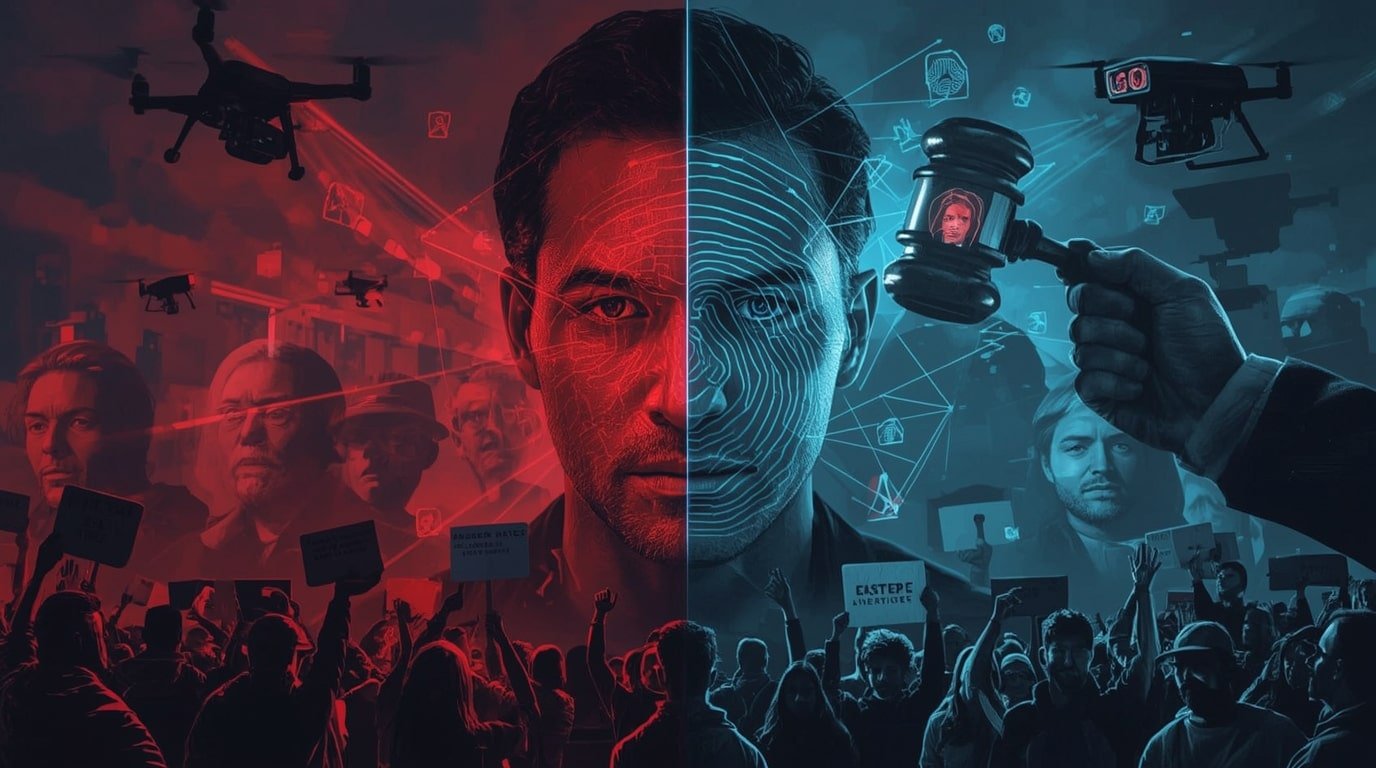
With facial recognition technology becoming more and more integrated into everyday life, through turnstiles in stadiums and cameras in street corners, people are suing in droves to reveal the dark side of this technology.
Class suits and daytime regulatory busts have been heaped on tech giants, as well as on retailers, in 2025 alone, asserting all the way up to unauthorised gathering of data, to unjustified arrests based on faulty algorithms.
Nobody can see a single federal law, which is why these battles are creating a reckoning: Is the hope of increased security worth sacrificing privacy and increasing biases? Wrigley Field in Chicago to the Ring doorbells at Amazon, the courts are turning out to be the venue where the biometric surveillance is going to receive the greatest challenge ever.
The Biometric Privacy Litigation Surge
Facial recognition accountability has reached a breaking point in the year 2025. The country has the hardest such law, which is the Biometric Information Privacy Act (BIPA) of Illinois, which still propels the charge.
Law BIPA, enacted in 2008, requires explicit and written consent prior to the collection or storing of facial scans by companies, and the statutory damages are high a maximum are $5,000 per negligent violation and $15,000 per purposeful violation. The punitive power of everyday consumers is transformed into everyday regulators since individuals can sue irrespective of who is in control.
Consider the Wrigley Field disaster of the Chicago Cubs. In September 2025, the proposed class action was initiated in the Northern District of Illinois by fans who alleged that the team and its vendors of facial recognition equipment employed such surveillance at the entrance gates without obtaining the necessary signed releases.
The suit claims that since people ran through gates, there were covert cameras that took biometric templates of unique geometries of faces based on eye spacing, nose width and jawlines without disclosure or opt-out.
Millions of damages are demanded by the plaintiffs, an example of how venues pursuing frictionless entry are crushing consent. The same complaints have befallen retailers: Target is now embroiled in a lawsuit claiming that it secretly scans the faces of shoppers to identify persons of interest, collecting information on unsuspecting customers.
Once, Facebook, Meta Platforms, was still a lightning rod. In 2015, an updated version of a 2013 class action by Illinois resident Clayton Zellmer states that the company has been scanning the faces of non-users in uploaded photos using its Tag Suggestions feature and creating face signatures without their consent.
The present case highlights how the tech giant remains exposed, even though it paid a suit related to this case, amounting to 650 million dollars, in 2021. The courts have confirmed that BIPA is far-reaching by permitting claims to be initiated without any actual damage, as seen in the landmark case of Rosenbach v. Six Flags.
Top-drawer Targets: Clearview AI and Beyond
There is no company that represents the biometric backlash as the facial recognition startup, Clearview AI, which scraped billions of images on the internet to create a shadowy database offered to law enforcement agencies and corporations. Clearview settled a massively expansive biometric privacy lawsuit in April 2025 with a settlement of 51.75 million dollars, including both cash and creative equity.
An unusual arrangement in which the class members are given a 23% share in the company, subject to future profitability with regard to the alleged privacy harms, was greenlit by a federal judge working in Chicago. The suit accused Clearview of retaining facial biomarkers, or inadmissible pieces of data such as iris scans or gait signatures, without obtaining consent, allowing reverse-image searches to break anonymity.
That was not the end of the misfortunes faced by Clearview. In April, Vermont Attorney General Charity Clark again filed a consumer protection lawsuit accusing the company of surveying the faces of Vermonters, including children, using public internet websites and withholding access to federal agencies.
Clark, who sought injunctions and restitution, was greatly upset by such practices, more so with children. In 2020, the American Civil Liberties Union had its own 2020 BIPA action, which continues to grind through appeals, seeking to stop the data profiteering of Clearview.
Retailers aren’t spared. In December 2024, the Federal Trade Commission (FTC) resolved a case with Rite Aid, imposing a five-year ban on the facial scans performed in-store by the chain because the agency claimed it was conducting discriminatory surveillance, labelling minorities as shoplifters (proportionately).
Based on that, the FTC was targeting IntelliVision Technologies in early 2025 with false claims of its zero-racial bias in the algorithms, using National Institute of Standards and Technology data to demonstrate otherwise. The cases are solidifying the use of algorithmic discrimination as a legal pitfall rather than a moral issue.
Prejudice, Unjustified Arrests, and Policemaker Accountability
Criticism through litigation is escalating to highlight the fallibility of facial recognition, which further magnifies racial and gender biases built into training data. In Detroit, Robert Williams was arrested in 2020 on a bogus match to a grainy surveillance video, and later settled in June 2024 with Detroit, requiring the technology to have more stringent usage requirements.
Williams, a Black father who was grabbed before his daughters outside the house, sued due to a violation of due process, claiming that the police did not show the tool had a false positive of 98% with people of colour.
This was increased by the ACLU in amicus briefs in cases. In January 2024, they supported the suit against New Jersey cops by Nijeer Parks, who was arrested in a hotel in 2019 based on erroneous scans. Parks, who was mistaken on the basis of a low-res photo, spent one night in jail; the fleeting argument is that such dependency is unclean of probable cause. In December 2024, another filing supported a Michigan wrongful arrest claim with a decree directed at the uncontrolled use of Detroit.
Ring cameras of Amazon are not spared. In November 2025, a study by the Electronic Frontier Foundation criticised the face-tagging capability of the doorbells, noting that it bypassed the consent requirements, but encouraged users to construct their own surveillance systems, which would be integrated into larger systems. In New York, a FOIL suit in Surveillance Technology Oversight Project against the NYPD is to receive records on Times Square deployments claiming secret scans during protests.
This is enhanced dystopianly by Immigration Enforcement. In its November 2025 expose of the ICE Mobile Fortify app, officers are bypassing citizenship proofs on biometric matches, dragging U.S. natives to deportation. As databases such as those of DHS, the IDENT, have 270 million records, data mining instruments bypass warrants, much like the Terry Stop cases that banned fingerprinting as a routine practice.
Divides and Pushes to Federal Reform
The patchwork of biometric laws enforced in Illinois, Texas, and Massachusetts is a biometric patchwork of America, having loopholes that are exploited by border-crossing companies. States such as California require digital opt-outs, but authorities decry them as worthless box-ticks. The fact that Google, in the state of Illinois, paid off students scanning their faces using educational tools in the tune of 9 million dollars, highlights this.
The supporters shout the idea of a national standard with references to the AI Act of Europe, which categorises facial recognition as a high-risk tool with mandatory consent. In the U.S., laws such as the Facial Recognition and Biometric Technology Moratorium Act are stagnant, yet the flood of 2025 (more than 50 BIPA cases have been commenced) has the potential to jump-start Congress. Courts, in their turn, are creative: Rite Aid bias precedent, and Clearview equity carve-out are indications of a judiciary that does not want to give in to the uncontrollable advance of tech.
The Future: Responsibility or Devolution?
Such litigations are not just payouts, but foreshadow. The cumulative settlements have gone past 700 million, yet the actual pain lies in business upheaval-bans, audits and consent revamp. Transparent policies, bias testing, and data deletion protocols are non-negotiable to businesses, which means that privacy by design is what they should adopt. Technological use should also be probed by law enforcement, and the error rates of the affidavits should also be revealed to maintain due process.
Yet challenges persist. Startups, such as Clearview, switch to legitimate scraping, whereas global actors evade U.S. jurisdiction. With biometrics merging with AI, not to mention predictive policing to ad targeting, the 2025 lawsuits tell of a surveillance state in embryo.
Federal guardrails will continue to be absent, and in such a manner, the courts will continue to adjudicate the future one faulty scan at a time. The question remains, Will America control the watchers, or let the watched lose in the code?