
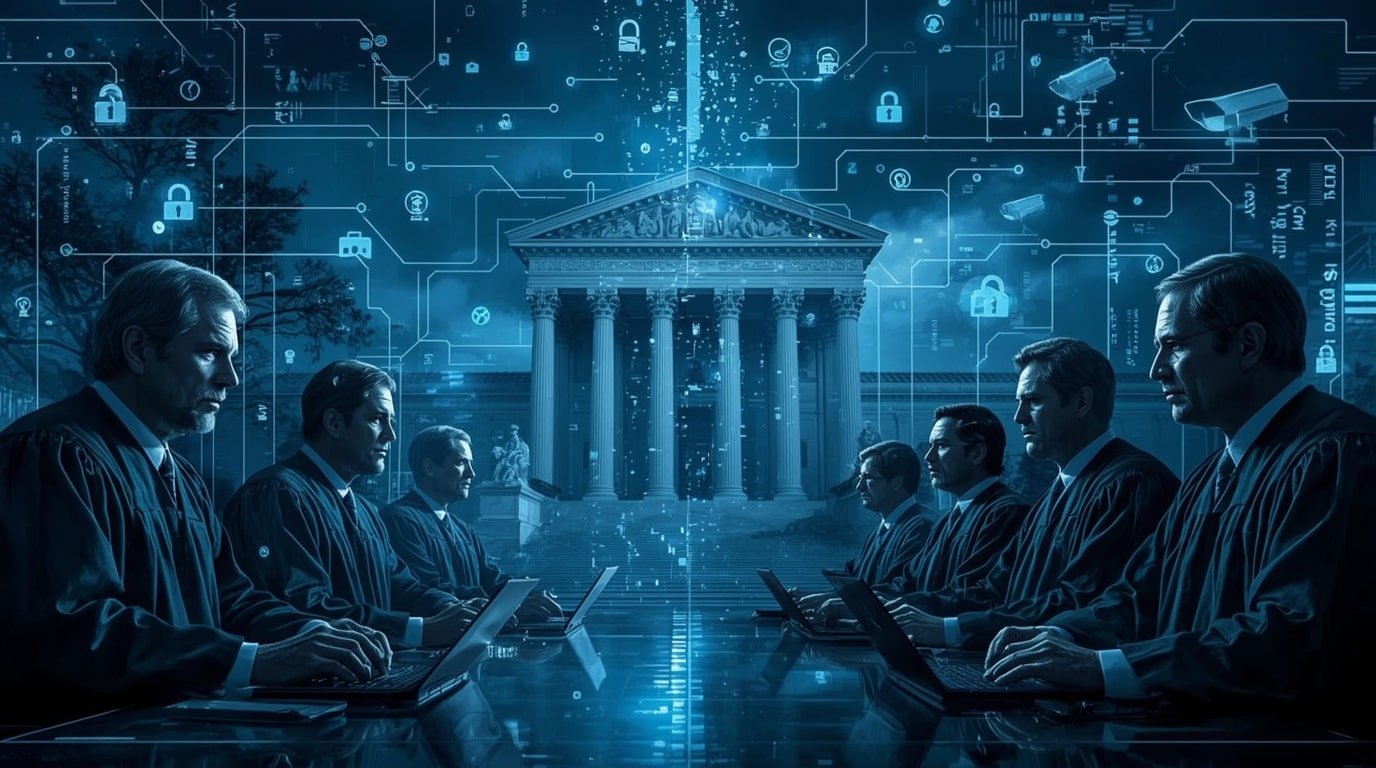
The U.S. Supreme Court has agreed to hear a consolidated objection to extensive government surveillance programmes in a historic ruling that may overhaul the national security and individual freedom regulations.
The cases, dubbed the Digital Liberty Docket, revolve around whether the federal agencies, such as the NSA and FBI, have the right to carry on sweeping data of online activities of Americans without a warrant in the name of counterterrorism. With privacy activists crowing over what could be called the tipping point, technology leaders and national security experts are on the verge of a reckoning that would cripple intelligence operations in the era of AI-related menaces.
This ruling has been made in the context of rising tension around digital overreach, which has been enhanced by the whistleblower exposures made by whistleblowers and through leaked documents. For many years, there have been programs such as PRISM and Section 702 in the Foreign Intelligence Surveillance Act that have permitted bulk collection of email, texts and metadata of U.S citizens who have been accidentally swept up by a foreign-focused net.
However, with smartphones being an extension of our neural wiring, and smart homes taking notes on us, critics believe the Fourth Amendment, with its protection against unreasonable searches, is being whittled away more quickly than Moore can keep up with the pace of change.
Snowden to Supreme Court: The Privacy Pendulum Swings
The saga dates back to 2013, when mass surveillance sparked outcry around the globe following the revelation by Edward Snowden. Reforms came afterwards- the USA Freedom Act at least pounded on some bulk phone metadata grabs- but loopholes remained. Jumping to the year 2025: A California federal appeals court invalidated major provisions of renewed Section 702 cases on grounds of permanent damage to civil liberties.
The decision was a result of a class-action lawsuit brought by the Electronic Frontier Foundation on behalf of 50,000 plaintiffs, comprising journalists, activists and ordinary users of Google whose data was being picked up without their agreement.
Similar fights are on in lower courts. A judge in New York stopped the FBI’s use of geofence warrants, which force Google to reveal location information on anybody in close proximity to a crime scene- hopefully incriminating thousands of innocent people.
A similar smackdown on facial recognition databases shared between local police and federal ICE agents was also seen in Texas, which was called a digital dragnet without due process. Such triumphs are based on the 2024 Carpenter v. Barr precedent that required warrants to conduct lengthy cell-site tracking, but judges now grapple with temporary data such as encrypted messages sent over the end and browser logs.
The change in legal thinking, according to legal scholars, is philosophical. One constitutional law professor, in recent testimony, said that the Founders had no foresight of TikTok, yet realised tyranny was a great secret. The docket of the Supreme Court, which is going to be subjected to oral arguments in March 2026, will involve how incidental collection infringes on privacy expectations in a hyper-connected world.
Tech Walking on a Thin Line: Innovation vs. Intrusion
It has not only been a matter of policy, but it is also the architecture of the internet. Once the compliant parties via compliance portals, Silicon Valley giants are a furious force in favour of reform. Tim Cook, the CEO of Apple, re-emphasised his position: Privacy is not a luxury; it is a fundamental human right.
However, platforms are in a catch, between submitting to government subpoenas and closing down, or going along and losing users. The recent EU penalties under GDPR have emboldened the suits in the U.S., with Meta being the subject of a $5 billion class action alleging that it shared user data with the agencies without warrants.
Security analysts respond by pointing out that any restriction of surveillance is an invitation to anarchy. We cannot afford no-fly zones, they were sworn aloud by a former NSA head in a congressional hearing. Statistics indicate a 300% increase in cyber-espionage since 2020, most of which is sponsored by states.
Such proposals as warrantless thresholds confined to the impending threats have been suggested, but are sceptical of judicial action, in remembrance of what Justice Brandeis had warned in 1928: The utmost of dangers to liberty are insidious encroachments by men of zeal.
Vigilant Voices: Activists and Officials Collide
The feel line in the streets and the hearing is sharp. In San Francisco, Black Lives Matter organiser groups and immigrant rights groups were out protesting after the ruling, denouncing surveillance as a weapon of institutional bias.
It is databases with our faces, it is protestant algorithms, it is pre-crime fiction, it is fact, one protester said. The intelligence committee leader of Capitol Hill, on the contrary, pledged to strengthen the wall against judicial encroachment, with a bill to make FISA power expansions codified.
The global repercussions are also observed. The Investigatory Powers Act of the UK is put under the same judgment, but China has its social credit system as an anti-utopian counterpart. Privacy NGOs such as the ACLU have speculated that a pro-privacy win of the SCOTUS would lead to global standardisation, which would reduce warrantless demands by 70%.
Horizon of Hope or Hurdle? The Road to Reckoning
The gavel comes nearer, 2026 will be a digital privacy renaissance-or reversion. The optimists see encrypted-by-default rules, where the courts require that all metadata grabbing be controlled by the courts. Pessimists predict a fractured implementation, in which the agencies would switch to collaborating with the private sector, where the spying would be outsourced.
This is not legalese, but it is existential. The whisper of the Supreme Court may be heard as a roar by the generations in the world where ideas are searchable, and loneliness is the result of an algorithm. The right to be left alone, as one of the judges of the first instance has expressed in her opinion, must change or disappear. To the 330 million Americans who have a digital shadow that is powering the surveillance state, it could not be any higher.